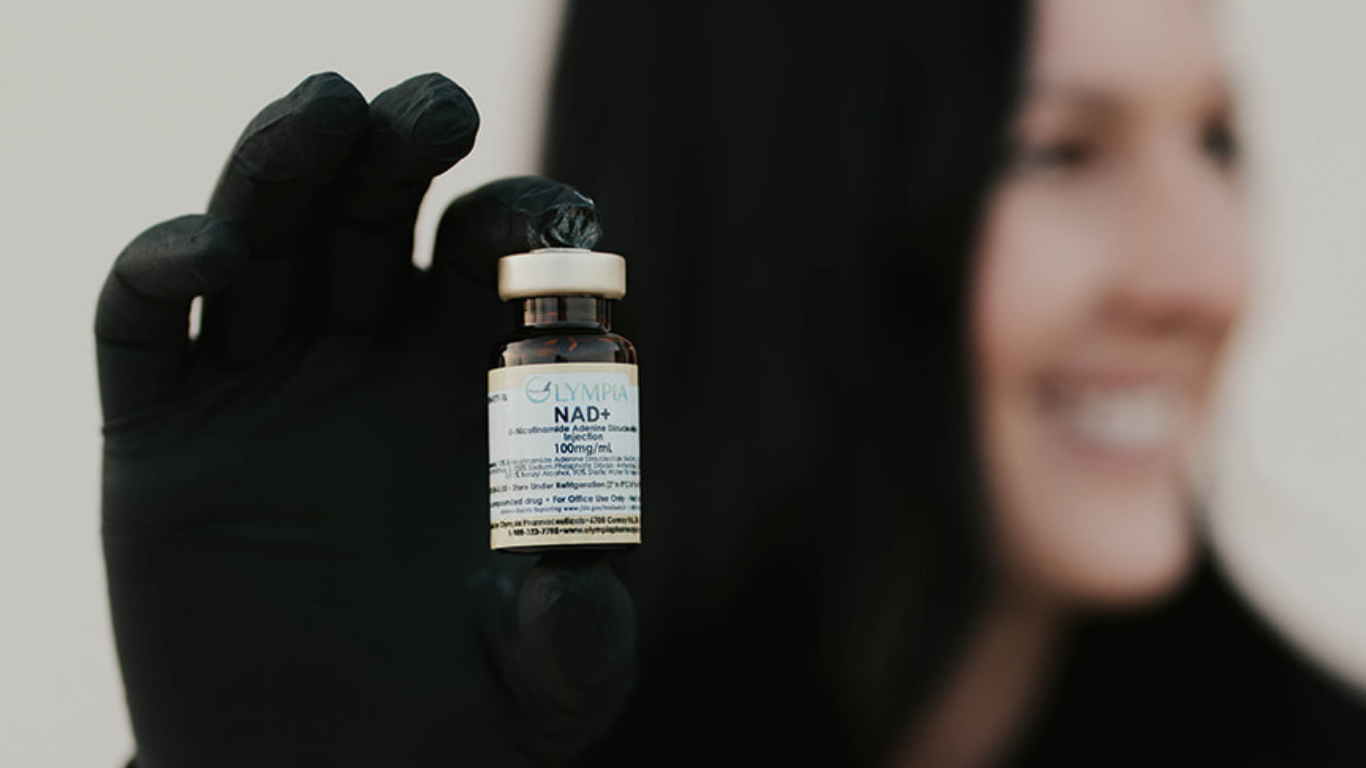
NAD+ is one of the most hyped molecules in wellness right now, and for some genuinely good reasons. Here is a grounded look at what NAD+ injections and IV therapy actually do, the questions people ask most, and how SALT. delivers it.
What does NAD+ therapy do?
NAD+ (nicotinamide adenine dinucleotide) is a coenzyme found in every cell in your body, and its core job is fundamental: it helps convert the food you eat into the cellular energy that powers everything you do. NAD+ injections and IV therapy raise your body’s NAD+ levels, which decline naturally with age (documented across multiple human studies). It is also involved in DNA repair and the maintenance processes that keep cells resilient, which is why interest in restoring it has grown so fast.
Is NAD+ like Ozempic? Can it help you lose weight?
This is one of the most common questions, and the honest answer is no, NAD+ is not like Ozempic. Ozempic and similar GLP-1 medications are prescription drugs proven to drive significant weight loss. NAD+ is a coenzyme involved in energy metabolism; it is not a weight-loss drug and should not be expected to work like one. Some people pursue NAD+ as part of a broader wellness and energy routine, but if your primary goal is weight loss, GLP-1 therapy (not NAD+) is the evidence-backed path. We would rather tell you that plainly than blur the line.
Does NAD+ therapy actually work?
Here is the straight version. Studies reliably show that NAD+ therapy raises your NAD+ levels and is remarkably well-tolerated, even at higher doses (per a 2026 systematic review of the human evidence). What is still being confirmed in humans is how fully that translates into the energy and anti-aging benefits people are most excited about, and those results have been promising but mixed. The foundation is real and the research is moving fast; it is simply earlier than the loudest hype suggests.
The honest case for NAD+: a hypothesis worth understanding
Here is the reasoning behind NAD+, laid out so you can weigh it yourself. We know two things with confidence: NAD+ levels decline as we age, and NAD+ therapy reliably raises those levels back up. The appealing hypothesis is the natural next step. If low NAD+ is tied to aging, then restoring it should support healthier aging. That is a reasonable and genuinely promising idea.
Scientists would call this hypothesis plausibly causal, and it helps to know where that sits on the spectrum of certainty. At the weak end is “merely correlated”: two things that happen together with no known reason connecting them, like ice cream sales and sunburns both rising in summer. At the strong end is “proven in humans”: large clinical trials showing that changing one reliably changes the other, the bar that GLP-1 weight-loss medications have cleared. “Plausibly causal” sits in between, and it is much stronger than a coincidence. There is a clear biological mechanism for why raising NAD+ should help, backed by supporting results in laboratory and animal studies. What is still missing is the final, decisive piece: large human trials confirming that raising NAD+ produces the anti-aging benefits people hope for.
A useful comparison is cholesterol. For years, the idea that lowering high LDL cholesterol would reduce heart attacks was “plausibly causal,” with a clear mechanism and strong supporting data, well before the large statin trials finally proved it. The hypothesis turned out to be right, but it genuinely took those trials to confirm it. NAD+ is at that earlier stage: a well-supported, mechanism-backed hypothesis on solid footing, not yet an established fact. That is a genuinely promising place for a therapy to be, far better than wishful thinking, but it is not a sure thing, and you should not let anyone sell it to you as one.
So where does that leave you? With enough to make your own call. What is certain: NAD+ therapy raises your NAD+ levels and is well-tolerated. What is promising but not yet proven: that doing so delivers the energy and longevity benefits people are after. Some people find the mechanism and early evidence compelling enough to try it as part of a broader wellness routine; others prefer to wait for stronger human data. Both are reasonable, and our job is to give you the honest picture, not to pretend the question is settled.
What is the downside of NAD+?
The main “downside” is comfort-related and easily managed: pushing NAD+ too quickly, most noticeable with the higher doses given by IV, can cause temporary flushing, mild nausea, or a feeling of pressure, all of which ease the moment the rate is slowed. That is exactly why an IV is given slowly with a nurse present. The other honest caveat is expectation: the broader benefits are still being studied, so it is best approached as a supportive part of a routine, not a guaranteed fix.
NAD+ injection vs. IV: how to choose
SALT. offers NAD+ by IV, by injection, or as a combination of both, and with any route you start with a loading phase to build your levels up, then move to ongoing maintenance. The real decision is not the dose; it is how you prefer to load and maintain. Here is the honest breakdown.
The combined approach (what we usually recommend): our typical protocol is to start with two IV loading doses about 2 to 3 weeks apart, which builds your NAD+ levels up efficiently, and then transition to self-injections about 3 times per week to maintain those levels steadily. This pairs the strengths of both: the IV does the heavy lifting up front, and the injections keep your levels consistent afterward without frequent nurse visits. For most people, this is the most effective and practical path.
By IV only: a nurse comes to you for a full infusion (about once a month for ongoing maintenance). It is the hands-off option, since you do nothing yourself. Because the dose is larger and less frequent, your NAD+ levels spike at the start and gradually dip before the next visit, and the higher dose tends to make the IV the more intense of the two, with more of that flushing or pressure sensation as it flows. Some people tolerate that sensation just fine, or even enjoy it, and still prefer the IV simply because a monthly visit feels like far less of a commitment than injecting a few times a week. A monthly visit also makes it easy to combine your NAD+ with other IV ingredients in the same session.
By injection only: you self-administer a small dose about 3 times per week. It takes a little comfort with self-injecting, and some people simply do not like giving themselves shots, which is completely fair. But it has real advantages: your NAD+ levels stay more consistent (no big peak-and-dip cycle), the lower doses are gentler so most people feel little to no discomfort, and it costs less because you are not paying for a nurse visit each time.
What it comes down to: the ongoing dose works out to about the same regardless of route, so the cost difference mostly comes down to the roughly $99 nurse visit fee for IV sessions. It is largely a preference: the convenience and combine-it-all-in-one-visit appeal of IVs, versus the steadier levels, gentler dosing, and lower cost of injections. The reason we usually recommend the combined approach, and lean toward injections for maintenance, is consistency: keeping your NAD+ steady tends to serve people better than riding the peaks and valleys of a big dose alone. All of these are perfectly good options, though, and your SALT. provider will help you choose what fits you during your consultation.
The SALT. difference
What sets SALT. apart for NAD+ is the experience around it. Whichever route you choose, it is medically supervised and supported by a licensed nurse: your IV delivered in the comfort of your home with someone right there to manage the drip and answer questions, and your injection plan set up and guided so you can maintain confidently on your own. Real oversight, your way, where you are.
Book a Mobile Visit With SALT.
Every SALT. treatment is delivered in your home, office, or hotel by a licensed nurse, with no clinic and no waiting room. Get in touch with our team to check availability or ask whether a treatment is right for you.
This article is for general education and is not medical advice. It is not intended to diagnose, treat, cure, or prevent any disease. Individual results vary, and a consultation with a SALT. provider is required before any treatment. Always talk with your physician before starting a new therapy, especially if you are pregnant, nursing, or managing a medical condition.